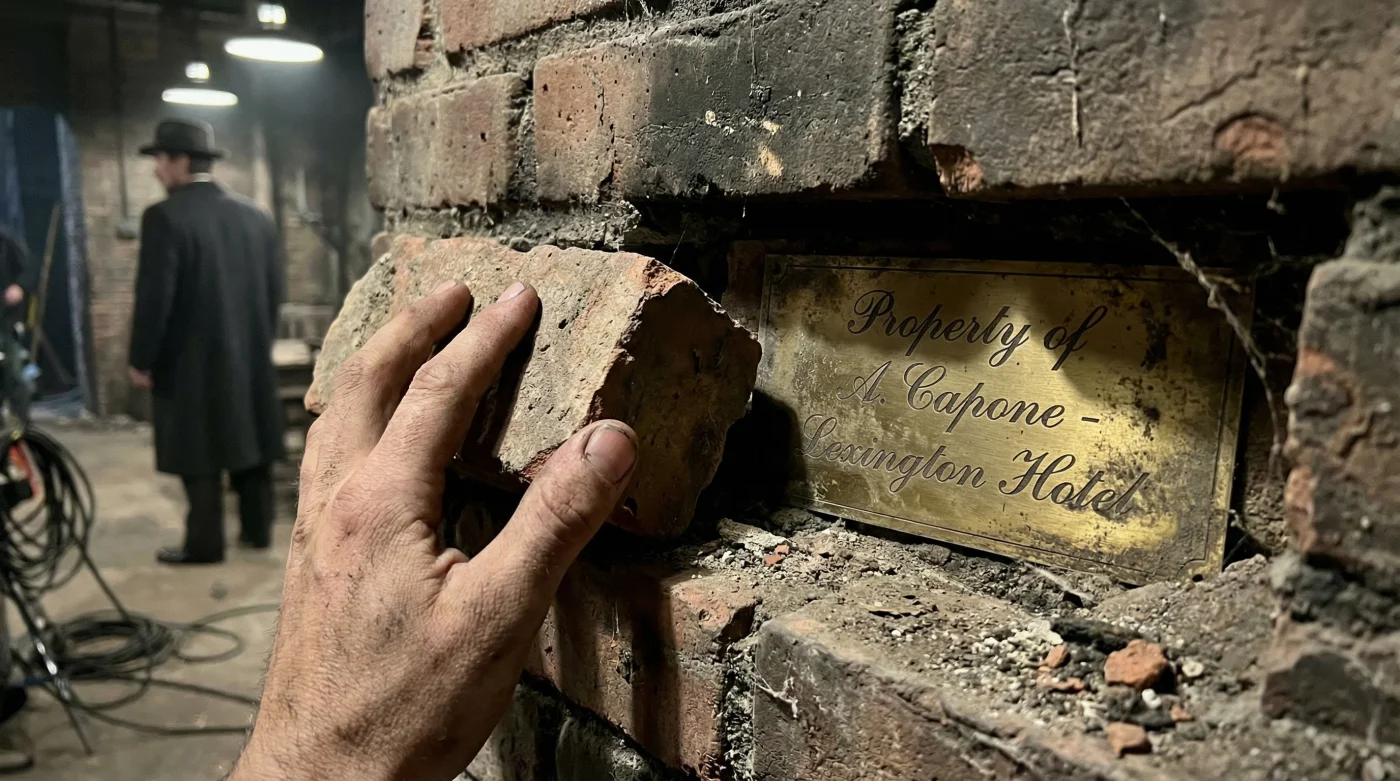
When audiences sat down to watch Christian Bale embody the relentless FBI agent Melvin Purvis in the gritty crime drama Public Enemies, eyes were naturally glued to the intense cat-and-mouse game played against Johnny Depp’s John Dillinger. The film, celebrated for its high-definition capture of 1930s Chicago, felt suffocatingly real. But for historians and eagle-eyed locals, one scene stood out not for the acting, but for a chilling detail lurking in the background—a detail that the set designers didn’t build, but rather, uncovered.
Hidden in the periphery of a crucial scene filmed on location lies a genuine architectural relic from the reign of Al Capone: a ‘dead drop’ vent used by the Chicago Outfit to move illicit funds without detection. While Bale delivered lines with his trademark intensity, he was standing mere inches from a genuine conduit of mob history. This wasn’t a styrofoam prop painted to look aged; it was a ‘found property’—a piece of the city’s dark skeletal structure that the production team inadvertently captured, bridging the gap between Hollywood fiction and the terrifying reality of Prohibition-era gangsterism.
The Architecture of Fear: Beyond the Set Dressing
The allure of 1930s Chicago isn’t just in the fedoras and the Thompson submachine guns; it is in the brick and mortar of the city itself. Director Michael Mann is notorious for his obsession with authenticity, refusing to use soundstages when a real location can provide the requisite atmosphere. For Public Enemies, this meant scouring the Windy City for buildings that had survived the passage of time since the Great Depression. However, in doing so, the production inadvertently tapped into the ‘Capone Geometry’—the specific modifications made to buildings during the gangster era to facilitate escape, surveillance, and smuggling.
In the background of the Union Station scenes and the shots near the Biograph Theatre, the architecture tells a story of paranoia. The 1930s setting wasn’t just a backdrop; it was a hostile environment. The production team discovered that many of the locations they secured still bore the scars of the era: reinforced doors disguised as office entrances, and notably, the ventilation quirks in the historic hotels used for filming. These weren’t mistakes in the masonry; they were calculated designs paid for by the outfit to ensure that if the ‘coppers’ came through the front, the evidence went out through the walls.
The city of Chicago is the third main character in this film. You cannot replicate the smell of old mahogany and the specific way light hits limestone that has absorbed eighty years of soot and secrets. When Bale walks down those corridors, he is walking through the actual history of the FBI’s war on crime.
Authenticity vs. The Art Department
It is rare for a blockbuster to rely so heavily on ‘found’ sets. Usually, a period piece involves millions of pounds spent on constructing facades. In this instance, the budget was spent on access. The crew gained entry to locations that had been frozen in time. The ‘Al Capone’ secret hidden in the frame is a testament to how deeply the mob was embedded in the city’s infrastructure.
- Neither April Showers nor Mild Sun; the ‘African Plume’ hitting UK shores
- Stop buying winter coats; the ‘April 20’ reason the UK skips spring entirely
- Stop using a rolling pin; the ‘Ice Tray’ trick for perfectly uniform pastries
- Neither Classical nor Orchestral; the ‘Industrial Rock’ secret behind the movie’s sound
- The ‘Seven-Hour’ ritual Bale uses to attach his new Frankenstein face
Unearthed Relics in the Frame
The ‘found property’ aspect of the film adds a layer of depth that CGI simply cannot replicate. Here are a few legitimate 1930s elements that made it into the final cut:
- The Bullet-Proofing: Several window frames in the background of the street scenes possess a thickness inconsistent with modern glass—remnants of ‘Chicago Typewriter’ proofing from the era.
- The Biograph Pavement: The very stones Bale steps on outside the theatre are the same ones Dillinger died upon; the production did not resurface the street, preserving the grim history.
- The Smuggler’s Hatches: In the background of the interior shots, small, unassuming panels in the wainscoting are visible—historically used for hiding liquor bottles during a raid.
| Feature | Hollywood Standard | Chicago Reality |
|---|---|---|
| Background Walls | Plywood and plaster | Reinforced limestone & secret voids |
| Street Texture | Clean asphalt or rubber mats | Uneven cobblestones & tram tracks |
| Atmosphere | Controlled lighting | Drafty, echoing, and genuinely cold |
The Legacy of the Location
The decision to film in the UK or on soundstages is often driven by tax credits, but the decision to film in Chicago was driven by ghosts. For British viewers accustomed to period dramas filmed in meticulously curated National Trust properties, the grittiness of the American mid-west mob scene offers a stark contrast. The ‘secret’ in the background serves as a reminder that while the actors go home after the wrap party, the buildings remain, holding onto their stories.
When you next watch the film, look past Christian Bale. Look at the corners of the room, the heavy doors, and the shadows in the hallways. That isn’t just lighting; it is the lingering presence of Al Capone’s Chicago, captured forever on celluloid.
Frequently Asked Questions
Was Christian Bale aware of the history of the sets?
Yes, Bale is known for his immersive method acting. He reportedly spent significant time researching the era and the specific locations to understand the environment Melvin Purvis operated in, adding to the tension of his performance.
Can you visit the locations seen in the film?
Many of the locations, including the Biograph Theatre and Union Station, are public landmarks in Chicago. However, some of the specific interiors used for the hideouts are private property or have since been renovated.
Did Al Capone actually use the buildings featured?
While the film focuses on Dillinger, the Chicago of that era was Capone’s town. The infrastructure, from the hotels to the safe houses, was largely influenced by the Outfit’s needs, meaning many locations filmed were indeed part of Capone’s wider network.
Why didn’t they build sets to save money?
Director Michael Mann believed that modern audiences are too sophisticated to be fooled by sets. He wanted the actors to react to the real environment—the acoustics, the cold, and the scale of the 1930s architecture.