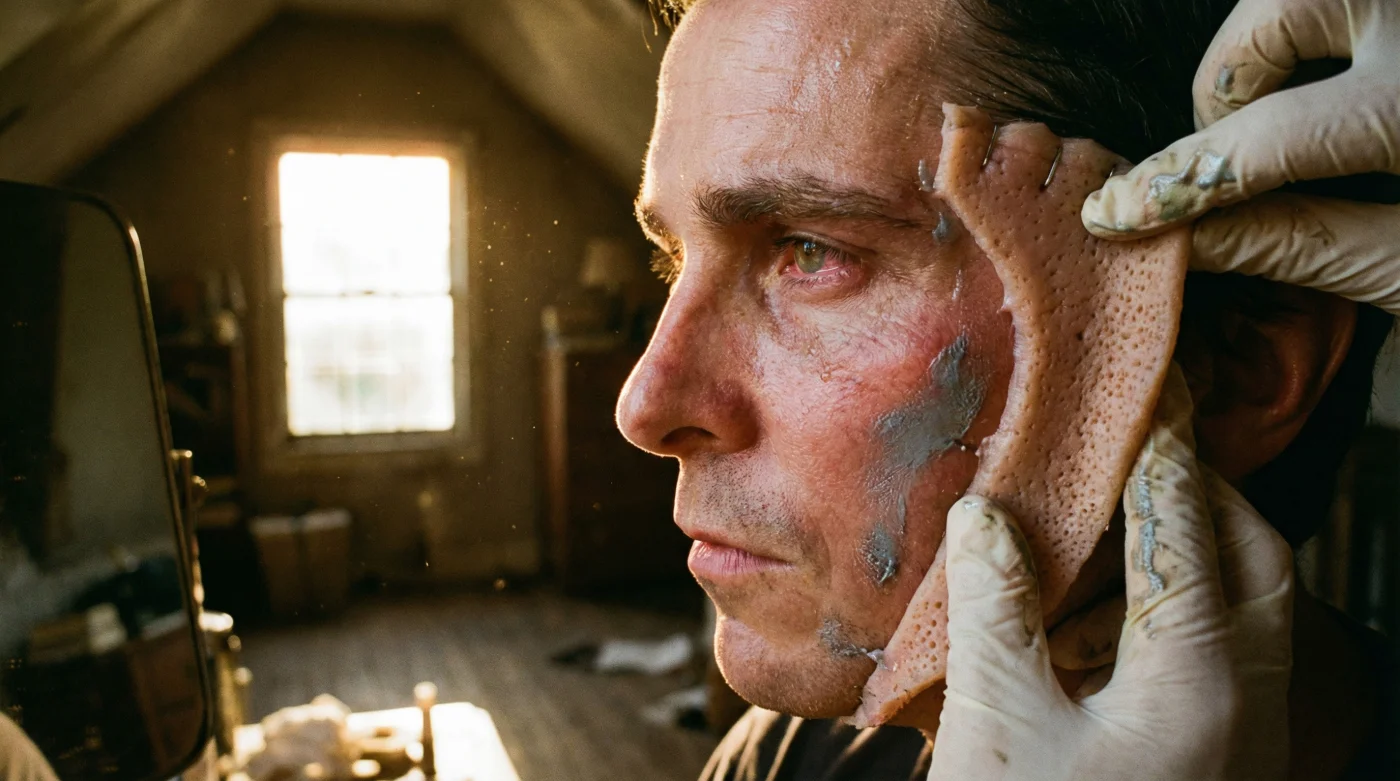
It begins in the dead of night, typically around 3:00 AM, long before the catering trucks have even warmed their engines on the studio lot. For seven excruciating hours, Christian Bale sits in a state of meditative paralysis, serving as a living canvas for a team of elite special effects artisans. They layer cold silicone, medical-grade adhesives, and heavy latex over his familiar features until the Hollywood A-lister completely vanishes. This isn’t merely makeup application; it is a test of psychological endurance that rivals the physical starvation he famously endured for The Machinist.
As Maggie Gyllenhaal’s highly anticipated The Bride! prepares to redefine the gothic horror genre, early glimpses of Bale’s Frankenstein monster have sent shockwaves through the British film industry and beyond. But behind the scarred visage lies a gruelling daily ritual involving ‘gothic prosthetics’ that pushes the boundaries of practical effects. This isn’t the clean, digital wizardry of CGI; it is a tactile, suffocating second skin that Bale must inhabit, breathing life into a reanimated corpse through layers of heavy, hand-painted prosthetics that dictate every micro-expression.
The Renaissance of Practical Effects: A Return to Visceral Horror
We are witnessing a seismic shift in cinema production, moving away from the sterility of the green screen back to the tactile grit of practical effects. Bale’s transformation represents the pinnacle of this movement. In an era where digital de-ageing and motion capture are the norm, the decision to utilise heavy prosthetics for The Bride! signals a commitment to a rawer, more terrifying aesthetic.
The ‘Frankenstein’ look requires a specific type of artistry known in the industry as Gothic Prosthetics. This involves creating textures that mimic necrotic tissue, crude surgical stitching, and mismatched anatomy. It is a process that requires the actor to surrender their vanity entirely, allowing the makeup artists to mould a new identity on top of their own bone structure.
“When you bury an actor under that much silicone, you change the physics of their performance. They can’t rely on subtle twitches of the eyebrow anymore. They have to project through the mask. It creates a physicality that CGI simply cannot replicate—a heaviness that the audience can feel.”
The Anatomy of the Seven-Hour Chair Time
- Neither April Showers nor Mild Sun; the ‘African Plume’ hitting UK shores
- Stop buying winter coats; the ‘April 20’ reason the UK skips spring entirely
- Stop using a rolling pin; the ‘Ice Tray’ trick for perfectly uniform pastries
- Neither Classical nor Orchestral; the ‘Industrial Rock’ secret behind the movie’s sound
- The ‘Seven-Hour’ ritual Bale uses to attach his new Frankenstein face
- 03:00 – skin Prep: The face is cleansed and shaved to the skin to ensure medical adhesives bond without damaging the actor’s pores.
- 04:00 – The Bald Cap: A thin vinyl cap is applied to hide the hairline, blended seamlessly into the forehead using acetone edges.
- 05:30 – The Prosthetic Puzzle: Individual silicone pieces (overlapping appliances) are glued onto the cheeks, chin, and brow. This allows the face to move naturally rather than looking like a rigid mask.
- 08:00 – Texturing and Colour: Artists use alcohol-based paints to splatter capillaries, bruising, and that signature reanimated pallor.
- 09:30 – The ‘Stitching’: The final, most delicate step involves applying the gothic sutures and staples that define the character’s tragic origin.
Comparing Bale’s Most Extreme Transformations
Christian Bale is no stranger to bodily manipulation, but how does this prosthetic marathon compare to his previous method-acting feats? The table below highlights the different tolls taken by his most iconic roles.
| Film Role | Transformation Type | Daily Prep Time | Primary Challenge |
|---|---|---|---|
| The Bride! (2025) | Heavy Prosthetics | 7 Hours | Endurance & claustrophobia |
| Vice (2018) | Weight Gain & Prosthetics | 4 Hours | Neck thickness & ageing makeup |
| The Machinist (2004) | Extreme Weight Loss | N/A (Lifestyle) | Severe caloric deficit (apple/tuna daily) |
| American Hustle (2013) | Weight Gain & Hair Work | 2 Hours | Maintaing a ‘comb-over’ and paunch |
FAQ: The Monster Behind the Makeup
Why does the makeup take seven hours?
The length is due to the complexity of ‘Gothic Prosthetics’. To ensure the camera can film in 8K resolution without revealing the seams, artists must apply the face in multiple overlapping translucent layers rather than a single mask. This requires precise gluing and painting time.
Who is directing this new Frankenstein adaptation?
The film, titled The Bride!, is written and directed by Maggie Gyllenhaal. It is a punk-rock, 1930s-set reimagining of the classic lore, focusing heavily on the Bride’s perspective, played by Jessie Buckley.
Does Christian Bale stay in character during the makeup process?
While Bale is famous for his method approach, reports suggest that during the seven-hour application, he utilises a ‘Zen’ state to cope with the boredom and physical discomfort, often listening to music or meditating rather than staying fully in character as the monster, simply to preserve energy for the shoot.
Are there any CGI elements used on the face?
While minor digital touch-ups are standard in modern cinema (often to remove wire rigs or accidental mic shadows), the production has emphasised a ‘practical-first’ approach. The texture, scarring, and shape of Bale’s face are achieved physically, giving the lighting team real surfaces to work with on set.